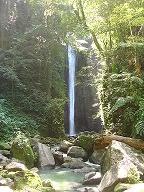
Even explorers and scientists are amazed by the diversity of our forests............ Many thanks to tarawatney for sharing this video (Philippines Forgotten Forest) on youtube.
Wednesday, July 21, 2010


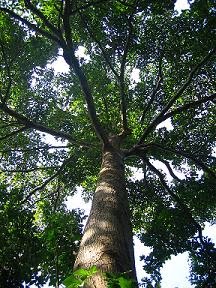
Lamio (Dracontomelon Edule) the cousin of Dao.
 Local name: Lamio
Scientific name: Dracontomelon edule
Family: ANACARDIACEAE
Description: medium to a large tree with high buttressed roots
Habitat: observed this mother tree growing on the slopes in Calauan, Laguna
Uses: used as furniture, veneer and interior construction; kernel of the seed, flowers and leaves are cooked and eaten in Papua New Guinea.

*note: Looks very much the same as Dao when it is still small, but as it grows the fruits, seeds and leaflets will be larger. Ther bark of Lamio is color brown while that of Dao is somewhat creamy. Proportion and shape will also be different.
Monday, July 19, 2010
Climate Change: A Battle We All Need to Fight In Order to Survive.
Looking outside my window is a mature Bagras tree that stands magnificently despite the battering of typhoons........ I keep thinking of the battle scenes from the Lord of the Rings and Avatar movie, wherein century old forest trees played a vital role to form a strategic alliance with man, beings and other creatures in order to save the world. Though fictional, these movies entail realism of our present world and what could happen in the future.
In the problems we face today, climate change is our greatest enemy. We ourselves have destroyed the forest fortress and that the balance of life has been disrupted. The elements of earth, fire, air, water and Gaia seem to have turned against us, magnifying nature's intensity into the likes of hailstorms, tsunami's, el nino, landslides, forest fires, drought and the like. My question now is how are we going to win this battle when almost all of the world's giant trees (our allies) are already felled or when constant use of fossil fuel and garbage continue to pollute our surroundings?
It is easy to say that tree planting is the solution. I'd say that it is partly correct, because we need to start somewhere in order to bring back the trees. What we do not have is the element of time, because it took years, centuries and millenniums in order to grow those trees. Some seedlings do not stand a chance from extreme changes in temperature whether hot or cold. They are similar to infants that need nurturing and care for them to grow strong and healthy, otherwise they will just wither away. Best way is to plan carefully as to what species to plant that would best adapt to an area. There should be a follow up on giving care and maintenance while seedlings are still establishing themselves. Finally, everybody should make it a conscious effort to join this battle, after all it is the survival of every species on the planet that is at stake including man.
In the problems we face today, climate change is our greatest enemy. We ourselves have destroyed the forest fortress and that the balance of life has been disrupted. The elements of earth, fire, air, water and Gaia seem to have turned against us, magnifying nature's intensity into the likes of hailstorms, tsunami's, el nino, landslides, forest fires, drought and the like. My question now is how are we going to win this battle when almost all of the world's giant trees (our allies) are already felled or when constant use of fossil fuel and garbage continue to pollute our surroundings?
It is easy to say that tree planting is the solution. I'd say that it is partly correct, because we need to start somewhere in order to bring back the trees. What we do not have is the element of time, because it took years, centuries and millenniums in order to grow those trees. Some seedlings do not stand a chance from extreme changes in temperature whether hot or cold. They are similar to infants that need nurturing and care for them to grow strong and healthy, otherwise they will just wither away. Best way is to plan carefully as to what species to plant that would best adapt to an area. There should be a follow up on giving care and maintenance while seedlings are still establishing themselves. Finally, everybody should make it a conscious effort to join this battle, after all it is the survival of every species on the planet that is at stake including man.
Wednesday, July 14, 2010
In design, sometimes LESS is MORE, but in rainforestation I'd say MORE is MORE!
We often hear designers and architects associate modernism to simplicity, clean, uncluttered and maintenance free. This is what most of us want to achieve in this modern world because we want our lifestyle to reflect beauty, comfort and style minus the headaches. Concepts are made and formulated to meet demands and requirements, but no matter what the end result is everything should serve a purpose. Nothing should be put to chance otherwise all efforts will be wasted.
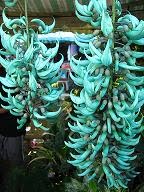
I wish that I can say the same about rainforestation. That I can just plant seedlings in rows and watch them grow their way into the garden of Eden that we envision them to be. It takes more than that because there is life in trees and plants and that we can never control nature, time or the elements. We often say that life is unfair. Well, life as we know it is certainly full of uncertainties. Unexpected things could happen to your seedlings/trees like for example your brother's pitbull ate your one and only germinating Manaring (lithocarpus sp.) seed, which you collected from a forest in Tagaytay. Or when the time that your jade vine was already making it's way up the fence that a sudden infestation of moth larvae gorged on the leaves that it was too late for you to take drastic measures to save it. There was even an instance when unexperienced you made some unforseen errors in handling and storing Tindalo seeds that when the time you got back from the trip and planted it, almost all of it perished due to fungus or bacteria. What a waste! In the end, you try to learn from these mistakes and hope to never ever do it again.
Enough about reminiscing the past because there is nothing to it. Nothing to bring it back I mean so might just face life head on. Like in a forest, life is teaming with species, one dependent on the other to form that symbiotic relationship or an ecosystem. Rainforestation is mimicking and bringing back that ecosystem. It is the closest thing that we can offer because we can never ever recreate the original virgin rainforest once it is destroyed. Diversity is the key. The weakness of one will be the strength of other species. I am talking about the layer upon layer of plant and tree species in one area. Try to adapt that concept and maybe then you'll agree with me that in rainforestation, more is more!
I wish that I can say the same about rainforestation. That I can just plant seedlings in rows and watch them grow their way into the garden of Eden that we envision them to be. It takes more than that because there is life in trees and plants and that we can never control nature, time or the elements. We often say that life is unfair. Well, life as we know it is certainly full of uncertainties. Unexpected things could happen to your seedlings/trees like for example your brother's pitbull ate your one and only germinating Manaring (lithocarpus sp.) seed, which you collected from a forest in Tagaytay. Or when the time that your jade vine was already making it's way up the fence that a sudden infestation of moth larvae gorged on the leaves that it was too late for you to take drastic measures to save it. There was even an instance when unexperienced you made some unforseen errors in handling and storing Tindalo seeds that when the time you got back from the trip and planted it, almost all of it perished due to fungus or bacteria. What a waste! In the end, you try to learn from these mistakes and hope to never ever do it again.
Enough about reminiscing the past because there is nothing to it. Nothing to bring it back I mean so might just face life head on. Like in a forest, life is teaming with species, one dependent on the other to form that symbiotic relationship or an ecosystem. Rainforestation is mimicking and bringing back that ecosystem. It is the closest thing that we can offer because we can never ever recreate the original virgin rainforest once it is destroyed. Diversity is the key. The weakness of one will be the strength of other species. I am talking about the layer upon layer of plant and tree species in one area. Try to adapt that concept and maybe then you'll agree with me that in rainforestation, more is more!
Tuesday, July 13, 2010
ANABIONG (Trema orientalis) is one of the fastest growing trees I've seen.

 Notice the difference in leaf size on the lower right hand pic. The larger leaf belongs to a seedling or a young tree while the smaller leaf on top belongs to a mature tree.
 Considered as a pioneer tree, Anabiong (Trema Orientalis) belongs to the hemp family ULMACEAE / CANNABACEAE. Other synonymous names according to wikipedia are Pigeon Wood and Gunpowder Tree. Surprisingly, Anabiong has numerous uses. Its wood is good for paper, pulp and rope production. The leaves are a source of food for butterfly larvae and fodder for livestock, while the fruits are eaten by birds and other wildlife. It is a nitrogen fixing tree, thus it is able to enrich the soil. Usually growing in open bushland and waste places. This species is one of the fastest growing trees I've seen.
 / CANNABACEAE. Other synonymous names according to wikipedia are Pigeon Wood and Gunpowder Tree. Surprisingly, Anabiong has numerous uses. Its wood is good for paper, pulp and rope production. The leaves are a source of food for butterfly larvae and fodder for livestock, while the fruits are eaten by birds and other wildlife. It is a nitrogen fixing tree, thus it is able to enrich the soil. Usually growing in open bushland and waste places. This species is one of the fastest growing trees I've seen.
I have seen this tree here in Manila, Batangas (near the coastline) and in Laguna.
Subscribe to:
Posts (Atom)