Barely 2 1/2 hours of sleep and I arrived at my cousin's house in Mandaluyong, Manila at about 12:30am. A few minutes after, we set off towards Lucban, Quezon to attend the famous "Pahiyas" festival, which meant "precious offering" as a thankful gesture for previous bountiful harvest held annually. The early departure was suppose to avoid traffic from the influx of festival goers and be able to park our vehicle near the festival venue as according to my cousin, particular town streets were going to be closed off at a later time to prevent further traffic and congestion in the area. There was no traffic and we passed by the newly opened SLEX (South Luzon Expressway) extension heading Sto. Tomas, Batangas in order to take advantage of this alternative route, plus the fact that we were not familiar to the much shorter Liliw, Laguna route via Calamba-Los Banos-Bay-Calauan.
Aft
 er 3 1/2 hours, about 4:00am, two of my cousins including their family were able to settle down. We parked the car within the parking area of the Lucban church and waited until 6am to hear mass, since it was a Sunday. By this time, the sun was just beginning to rise. A short drizzle added to the cold breeze that enveloped the area. Soon the mass started and we all could barely keep our eyes open. I felt like I was going to drop and hit my head from the front or rear pew. I could hear occasional giggles from the back. I just ignored them because maybe they were laughing at something else and I didn't want to get paranoid about it. It's a good thing that I didn't succumb to the urge.
After hearing mass, we bought a few dozen of the famous Lucban longganisa sausage and headed for Buddy's restaurant to have our breakfast of pancit habhab (sauteed noodles with mixed vegetables and shrimp served on a banana leaf without utensils), Lucban longganisa and for me a lumpiang gulay (stir fried vegetables and other ingredients wrapped in crepe-like wrapper served with a sauce and sprinkled with peanuts). Outside the restaurant was the town plaza, which
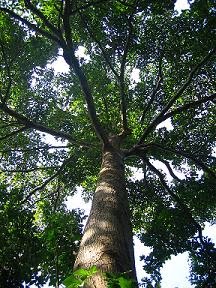
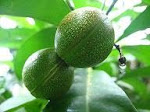
 will hold the venue for a television program, according to my cousin. But what really caught my attention was the presence of Kamagong (Diospyros discolor) trees that lined between the plaza and the street. Not only were some trees laden with hairy red-orange fruits called "Mabolo", otherwise known as Velvet apple, but the trees were blanketed with moss, ferns, lichens and probably hoya and orchid species. The scene reminded me of the mossy forest, places with high elevation and moist and cool climate.
 We the
 n walked one or two blocks away and soon arrived at the street where people seemed t
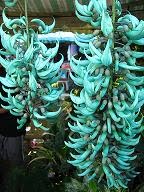
 o be congregating. I noticed that the houses on that particular street were completely covered with an assortment of indigenous plant materials, agricultural and horticultural produce, the famous "kiping" (brightly colored rice wafer molded from mature leaves of various flora used as decoration), including lesser-used forest products. The welcoming am
 biance of colorful and ingenious installations of almost extravagantly decorated houses proved that Filipino's are naturally creative at that. Not to mention that a few occasional houses allowed perfect strangers to enter their houses for further picture taking purposes only add to our hospitable and friendly culture.
I guess that being observant and inquisitive in nature enabled me to meticulously identify e
 ach item used to clad the houses. What inspired me to continue such effort was the discovery of used parts of indigenous or endemic flora, which was more often unfamiliar to me than being familiar. As such, I found myself to be more in
 the "plant hunting" mode than just being a spectator. That somehow the predator in me was unleashed and capturing my treasured find became more important than taking pictures of ornately embellished houses.

Maybe somebody can help me identify some of these species? Your input is most welcome!
Anyway, I didn't expect to be walking several blocks of houses that took a series of turns and walking under the intense he
 at of the sun. Portions of the streets were full of o
 nlookers and passers-by. There were a lot of visitors like me who brought their cameras along with them. I'm sure that some of them would be featuring digital photos into their own blogs or maybe in social internet sites such as facebook and multiply.
One thing th
 at stuck to my mind was that a lot of the participating houses incorporated indigenous and endemic forest products, which were obviously taken from the wild. If this was the case, th
 en would it be right to assume that the remaining forest near this part of town is being raped annually through over collection of fruits, leaves, flowers, branches or even the whole plant itself? How do the locals regulate themselves to ensure of species preservation and conservation for biodiversity to replenish itself? Please don't get m
 e wrong here, but I am only asking how regulation is being implemented. I am only saying that it is possible. Pahiyas is just one among several festivals being celebrated in the Philippines. What about the others that are similar to this type of nature?